
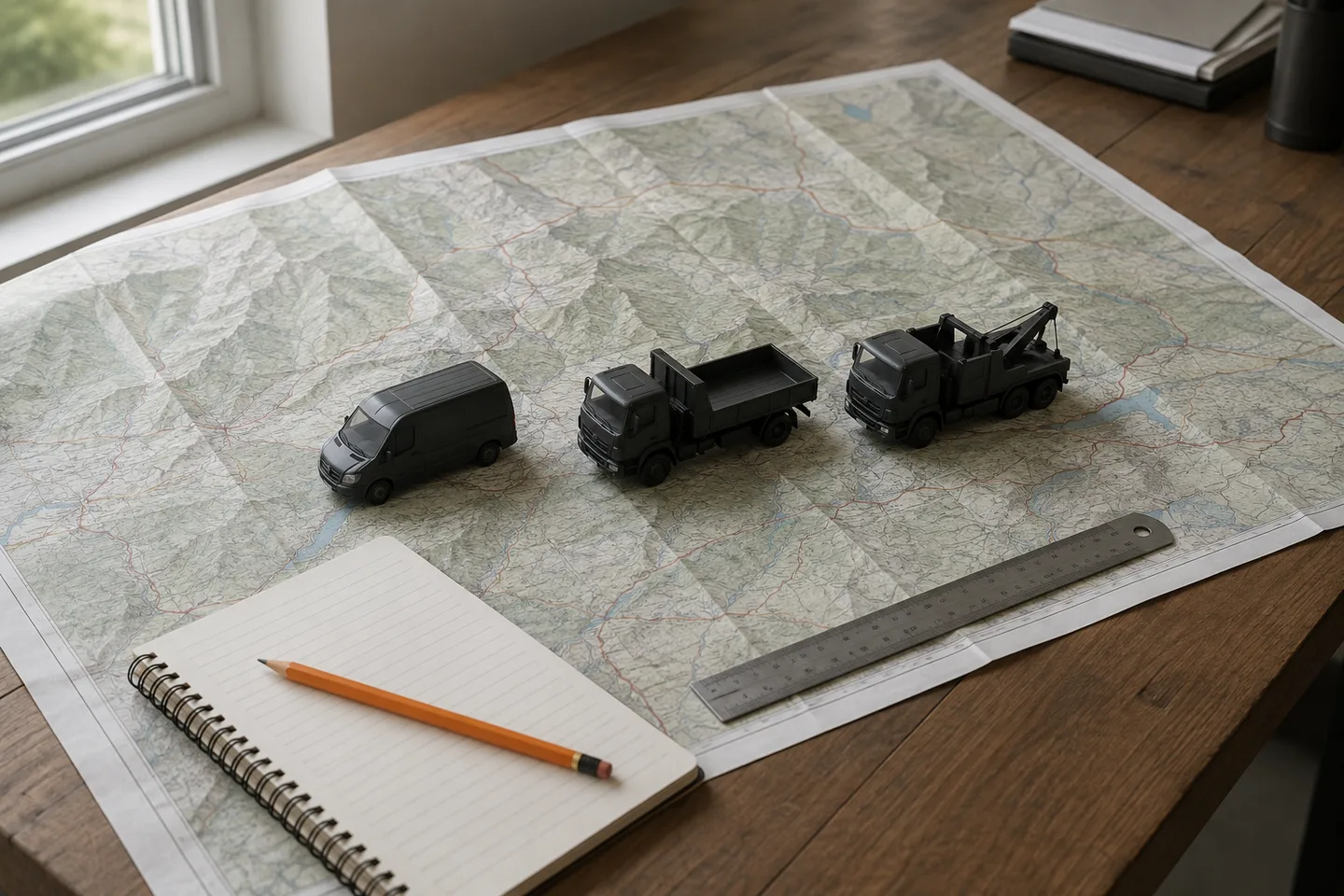
How do you define an emergency response fleet?
Plan an emergency response fleet from the incidents, coverage area and response sequence it must support. Separate core vehicles from supporting and conditional roles, then test the mix against crew, route, maintenance and destination constraints.
Build an incident and coverage profile
Describe the recurring incidents and the severe cases that occur less often, then locate the areas the fleet must cover. Set target response windows against travel distance and road conditions. Add climate and expected operating duration before deciding how many trucks are needed.
Group incidents only when the same primary vehicle can meet the required duty in each case. Keep distinct hazards, load cases and clinical workflows separate, and explain which operating requirement justifies each vehicle in the fleet.
Assign vehicle roles
Define primary vehicles that address the main duty, supporting vehicles that add a linked capability and conditional vehicles used only under stated circumstances. For example, mobile power may support a prolonged flood response but is not automatically required at every incident. An aerial platform may support utility work but should not be presented as a firefighting vehicle unless that duty is specified.
Map the deployment sequence. Note which vehicles must arrive first, which can serve more than one site and which depend on a trained crew, specific water source, stable ground or another support system.
Check operational capacity
Compare vehicle availability with staffing, training, maintenance and spare-parts capacity. Include planned downtime and the ability to service chassis and body systems. A larger fleet can reduce readiness if the operator cannot crew or maintain it.
Test the proposed mix against the incident that places the controlling demand on the fleet. Check whether the vehicles can reach the site, deploy and operate there, then return to service. Include route access and payload in that review, with the fuel, storage, communications and workshop support required.
Information to include in the fleet brief
- Incident types, frequency and controlling cases
- Coverage area, response windows and route conditions
- Primary, supporting and conditional vehicle roles
- Crew, shift, training and operator requirements
- Fuel, maintenance, consumables and spare-parts plan
- Destination rules, inspection method and document requirements
Turn the plan into procurement packages
Write a separate technical brief for each vehicle role. Use common radio standards and warning systems where useful, and keep documentation and training consistent across the fleet. Identify shared service items without forcing different bodies and operating duties into the same specification.
Compare costs over the same operating horizon
Compare every option over the same period and at the same utilization. Show vehicle and option prices separately from freight and insurance, then account for destination handling and local preparation. Each cost needs a source and date. Record its currency and responsible party too, so a difference in delivery terms does not hide a missing expense. [3]
Keep maintenance, downtime and residual value as explicit assumptions supported by local records where available. Compare conservative, central and adverse scenarios rather than presenting one precise lifetime total. If a small change in downtime or resale value reverses the decision, obtain better evidence for that input. Main-site illustrative costs are not Rescue quotations or promised savings. [3]
Turn each role into a separate RFQ
Use the mission index to review the vehicle roles, then prepare a vehicle-specific RFQ for each duty. Keep shared fleet interfaces consistent without assuming every vehicle needs the same equipment package.
Evidence boundary
This guide provides a planning method, not a standard fleet recommendation. Vehicle quantities, coverage performance, cost, availability and delivery timing require local operating data and project-specific confirmation.
Review checklist
- The incidents and coverage area the fleet must serve
- A role-based vehicle mix
- A fleet interface and maintenance plan
Sources
- [1]
- [2]
- [3]Special-Vehicle Landed & Lifecycle Cost ModelKEEYAK · reviewed 2026-09-07Source retained on file
Each source supports only the planning statement that cites it. For the selected vehicle, confirm the destination law and applicable editions, along with the evidence required for that project and jurisdiction.